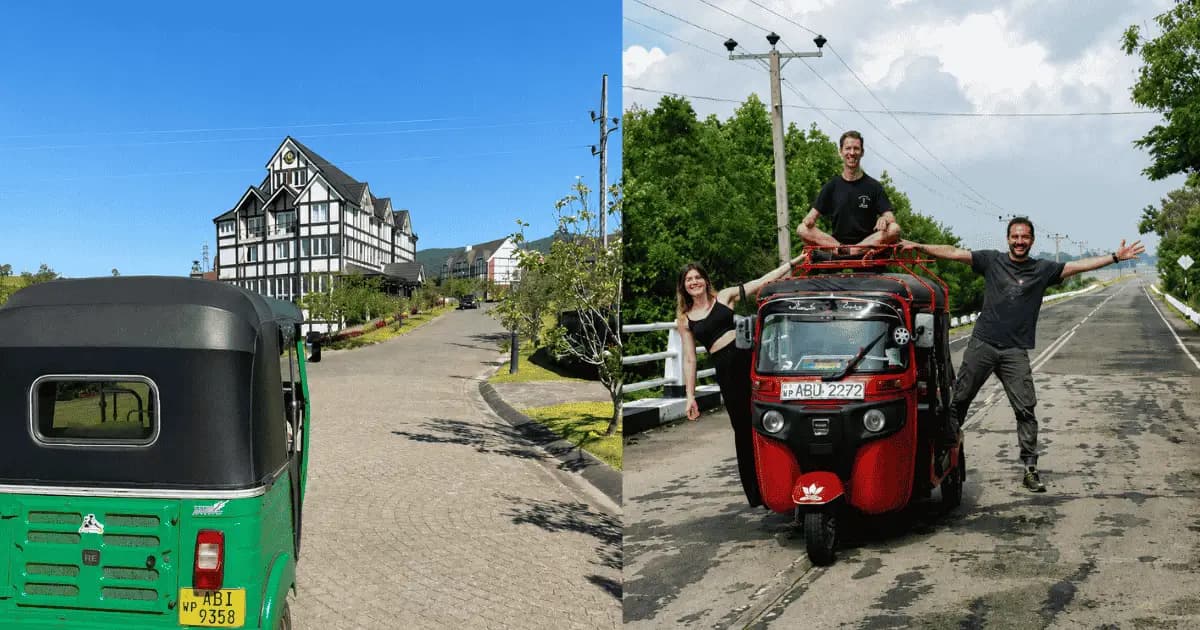
Renting a tuk tuk in Sri Lanka gives you access to roads no car can reach, a schedule you control entirely, and WhatsApp support every day of the year. It is not the fastest way to travel. It is not the most comfortable. But for independent travellers who want to move through Sri Lanka on their own terms, the case for a tuk tuk is straightforward.
What You Get When You Rent a Tuk Tuk in Sri Lanka
A tuk tuk fits through gaps a rental car cannot. Narrow village roads, coastal tracks between beach towns, mountain paths that dead-end for larger vehicles — all of these open up by three-wheel. You can stop anywhere, park without difficulty, and change direction without needing to find a turning point.
Most of the places travellers mention as highlights on their Sri Lanka trips are not on main roads. They are on the side roads a tuk tuk reaches in minutes. A bus cannot stop for them. A hired car can, but the driver is waiting and the clock is running.
No Fixed Schedule
When you rent a tuk tuk, there is no driver waiting. You leave when you want, stop when you want, and spend as long as you like in any one place. If you want to spend three hours at a viewpoint and skip the next town entirely, no one is in the vehicle to object.
Over 2,500 travellers have rented with Tuk Tuk Rental Negombo. The most common theme across reviews is not the vehicle itself — it is the freedom to stop wherever they wanted, something that does not exist when a driver is managing the schedule.
Fuel Costs Less Than You Expect
A tuk tuk averages around 25 km per litre of fuel on flat roads. On mountain roads the consumption increases — plan your fuel stops before entering any hill country section. On coastal routes and flat terrain, fuel costs stay low.
The rental rate starts at €9 per day. That covers full insurance, a tool kit, spare wheel, phone holder, USB charger, and 365-day WhatsApp support. Renters need a valid driver's license and an international driving permit suitable for Sri Lanka — see the rental guide for details. Fuel is the main cost on top of that. There is no deposit required at pickup.
Rain Does Not Stop the Journey
Every tuk tuk comes with rain covers you can lower while still moving. Sri Lanka's monsoon showers are typically short and intense rather than continuous — most clear within 20 to 40 minutes. You pull over, lower the covers, and continue. The tuk tuk is not waterproof at the sides when covers are raised, so keep them accessible.
Breakdown Support Is Available Every Day
Each tuk tuk comes with a full tool kit and a spare wheel. For common roadside issues — punctures, minor engine faults — the kit handles most of them. For anything more serious, three-wheelers are widely serviced across Sri Lanka and the all-island service dealer map provided at pickup covers the whole island.
WhatsApp support is available 365 days a year at +94 77 990 3257. For major mechanical problems, the team arranges repairs or a replacement vehicle. This is not a self-solve situation — there is a real person at the other end of the phone throughout your trip.
When a Tuk Tuk Is Not the Right Choice
A tuk tuk is not the right vehicle for every traveller. If you are not comfortable driving in left-hand traffic for the first time, a tuk tuk adds an extra adjustment on top. If your itinerary has very long daily distances, tuk tuks average 40–60 km/h on good roads and noticeably slower in the mountains — that adds hours to a packed schedule.
If you need air conditioning for medical or comfort reasons, a tuk tuk does not have it. If your trip is based entirely at beach resorts with no interest in road travel, a self-drive rental is probably not worth it. Sri Lanka Tourism offers an overview of transport options if you want to compare before deciding.
If none of those apply, the tuk tuk rental page covers everything that is included in the rate. The customer journey page explains the booking process step by step. For a full cost breakdown with no surprises, the day rate post covers all the numbers. If you have specific questions before booking, the FAQ page is the fastest place to start.